Designing a scalable permission system for complex client onboarding

Role & Scope
Product designer, led the end-to-end design strategy
Key Skills
Service Design, User Experience & Design Strategy
Cross-functional team
Founding product designer(me), Product Manager, and 1 Full-stack developer
Project Dynamics
2 Months, Launched Oct 2024
When I started working on the onboarding experience at Property Share, the problem looked simple: help advisors create clients, entities, and users. But as I spent more time understanding the workflow, I realized onboarding wasn't a form completion problem. It was a complexity problem.
Property Share serves multi-family offices where a single client relationship can include multiple legal entities, family members, advisors, and access requirements. As these relationships grew, onboarding became increasingly difficult to manage. Advisors were not just creating accounts, they were configuring an interconnected system of clients, entities, users, and permissions.
My goal was to redesign this experience so advisors could onboard clients faster while feeling confident that everything was configured correctly.
Understanding the complexity behind onboarding
As the only designer on the project, I led the research and design process end-to-end. I worked closely with advisors, internal teams, and product stakeholders to understand where onboarding slowed down and where users felt uncertainty.
Through workflow analysis, stakeholder conversations, and reviewing existing onboarding patterns, three major challenges emerged:
Client relationships were hierarchical.
A single client could own multiple legal entities, and each entity could have different users and access requirements.
The workflow was repetitive.
As portfolios expanded, advisors repeated the same setup actions across multiple entities and users.
Permissions became harder to manage at scale.
The more users and entities involved, the harder it became to manually configure and maintain access.
Insight:
The problem wasn't creating records. The problem was reducing the operational complexity of managing relationships between clients, entities, and users.
Reframing the problem
How might we reduce operational effort while helping advisors confidently configure access across complex client structures?
This shifted the focus from designing a collection of settings to designing a scalable system.
SOLUTION 1
Individual permissions
The first approach allowed advisors to configure access user by user.
While this provided maximum control, it quickly broke down at scale. Assigning permissions individually created repetitive work and increased the chance of configuration errors.

SOLUTION 2
Entity-level permissions
I explored assigning permissions directly at the legal entity level.
This improved control but introduced another layer of complexity. Advisors now had to make permission decisions repeatedly across every entity, increasing cognitive load during onboarding.

SOLUTION 3
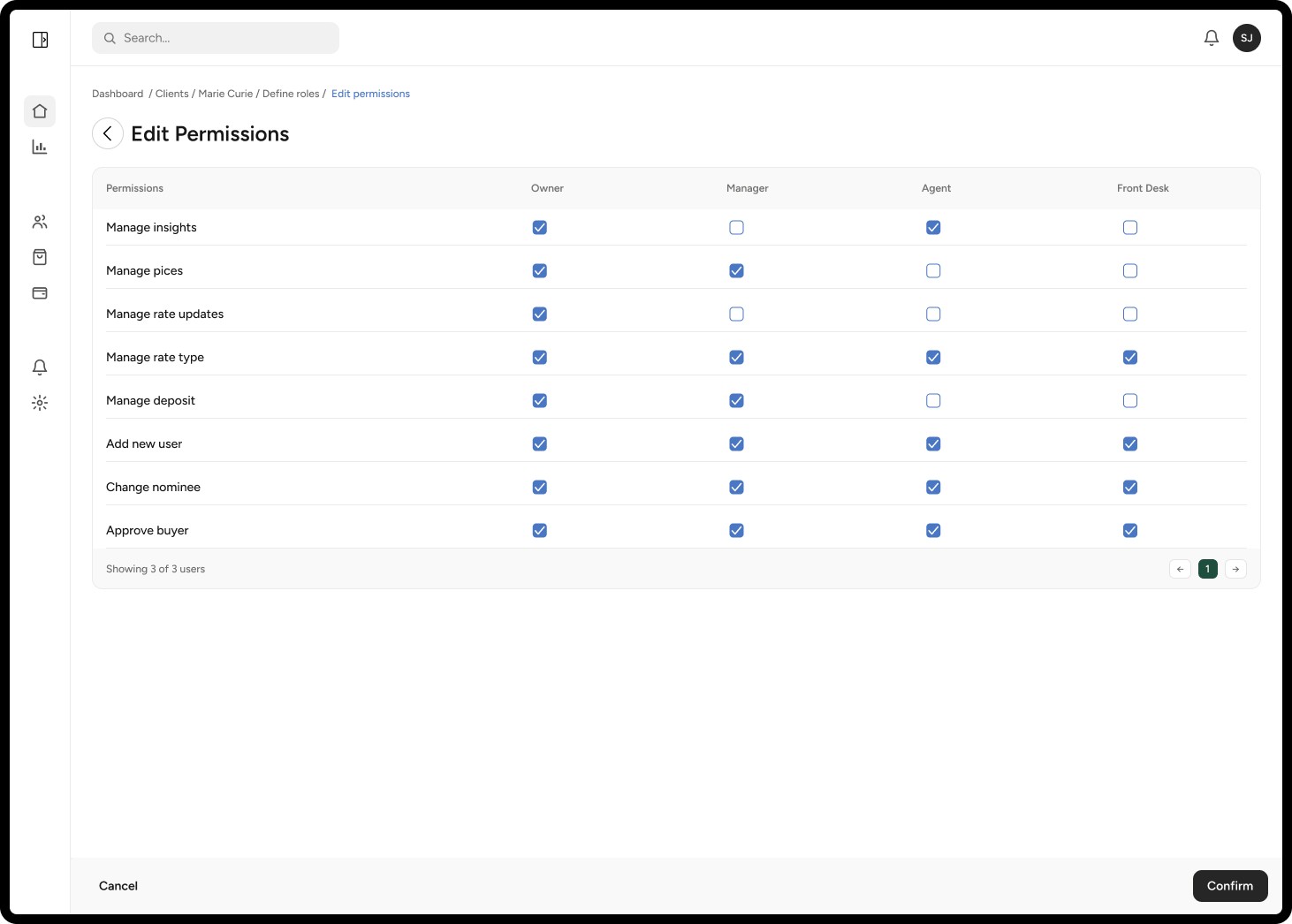
Role-based permissions
The next direction was creating predefined roles based on user responsibilities.
This simplified decision-making by allowing advisors to think about who someone is rather than what every individual permission should be.
SOLUTION 4
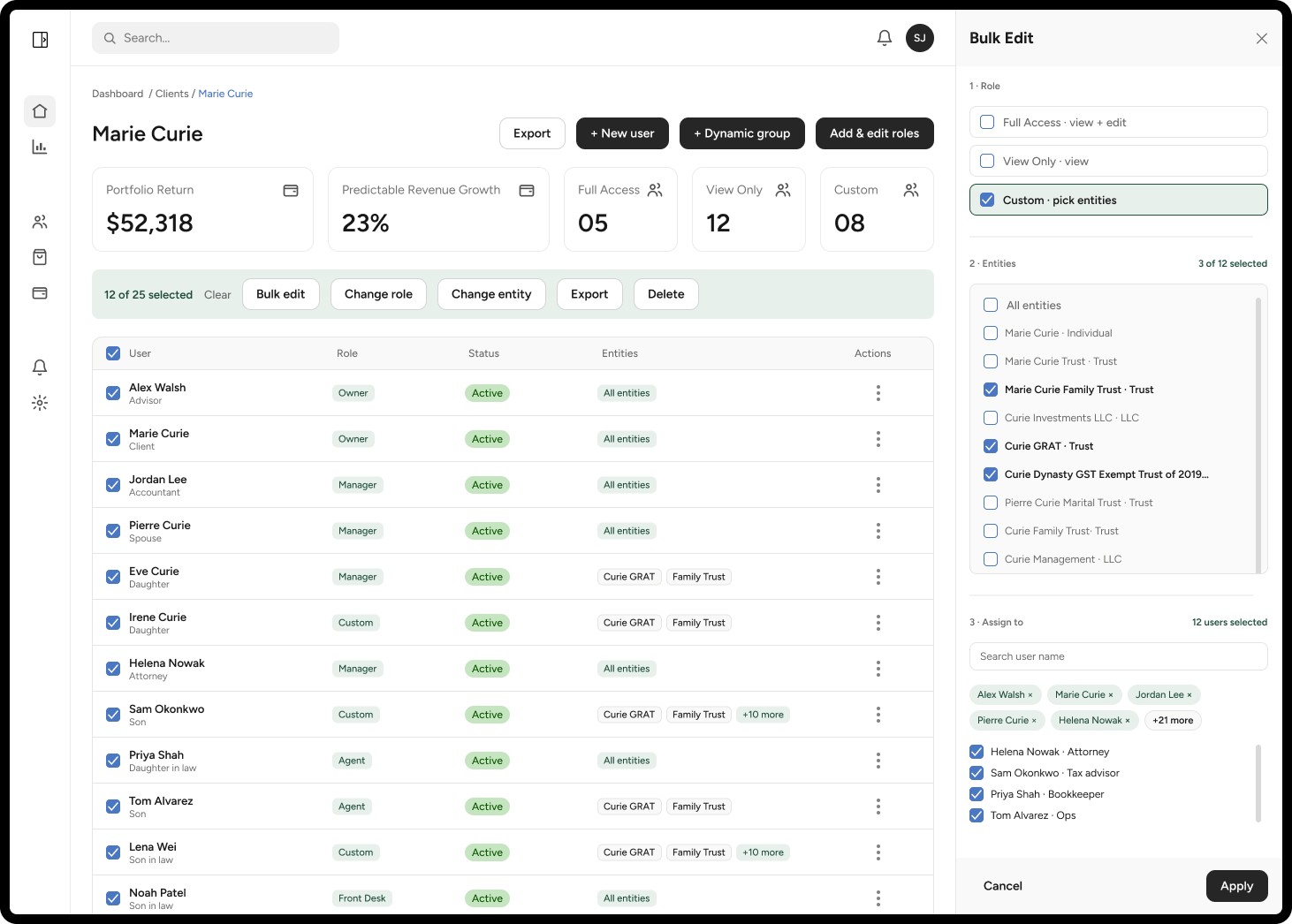
Bulk actions
I explored bulk assignment patterns to reduce repetitive configuration when multiple users required similar access.
This simplified decision-making by allowing advisors to think about who someone is rather than what every individual permission should be.
DIRECTIONAL OUTCOMES
Combined role-based permissions with bulk actions
I combined role-based permissions with bulk actions to create a workflow that balanced speed and control. Instead of forcing advisors to configure every relationship manually, the system allowed them to:
Assign access based on user roles
Apply permissions across multiple users at once
Maintain visibility and confidence throughout onboarding
The final experience reduced repetitive setup work while creating a foundation that could scale as client relationships became more complex.
REFLECTION
This project changed how I think about enterprise workflows. The challenge was never designing more controls. It was identifying which decisions users actually needed to make and removing unnecessary complexity around them.
By focusing on the advisor's mental model: relationships, responsibilities, and outcomes. I was able to design a permission system that supported both immediate onboarding needs and long-term scalability.