Helping executives grow the sales funnel by 40% while working on the go.

Role & Scope
As product designer, I led the end-to-end design of an investment advisor app; translating the business goal of increased sales productivity
Key Skills
Service Design, User Experience & Design Strategy
Cross-functional team
Product Designer (me), Product Manager, 1 front-end Developer, and 2 back-end developers
Project Dynamics
1 month, launched April 2024
Property Share needed to grow its sales funnel by 40%, but its sales tool slowed down lead tracking and client communication for executives on the go.
Problem at hand
33% of Property Share’s clients were international, operating across time zones while the sales team worked standard IST hours. This created a clear trade-off: work overtime, miss the client, or delay responses to high-value investors.
My role
To design a mobile workflow that helps executives manage leads and client communication beyond standard hours, keeping deals moving across time zones.
Sales Funnel
%
increase in qualified opportunities over 90 days
Lead Response Time
%
reduction in average response time for international leads
Follow-up Completion
%
increase in on-time follow-ups within 90 days post-launch
WHAT WAS ACTUALLY HAPPENING
A small team made the problem easier to uncover
I didn't need a formal research study to start seeing the gaps. A few informal coffee chats with sales reps revealed that they had already created their own ways of working around the limitations of the existing tool.
Some of these workarounds worked, but they also meant important sales activity was happening outside the system, slowing the team down and making the workflow harder to scale.
Reps were using personal notes, messages, reminders, and memory to keep track of clients and follow-ups. The work was getting done, but important context was scattered across different places.
Sending a document for signing meant opening a laptop and going through the desktop workflow. A two-minute client call could turn into additional work afterward, leaving the team feeling like they were always catching up.
The gap between when clients needed a response and when the team could access the system. An executive away from their laptop couldn't easily follow up, send documents, or pick up a conversation until they were back online.
PROBLEM DISCOVERY
After talking to the sales team and studying how the existing system worked, I realized that making the desktop experience responsive wouldn't solve what was actually slowing them down.
The sales team wasn't asking for a smaller admin panel. They needed a way to keep clients moving when they weren't sitting in front of a laptop.
ASSUMED JOB TO BE DONE (JTBD)
How do we make the admin panel responsive?
VALIDATED JOB TO BE DONE (JTBD)
What does a sales executive need to keep a client moving when they're not at their desk?
WHAT I INVESTIGATED NEXT
I first understood what we already had
Before adding anything new, I mapped the existing admin workflows, backend structure, data, and handoffs to understand what could actually be changed and what the mobile experience needed to complement.
The goal wasn't to rebuild the system. It was to understand what we could carry forward, what needed to be prioritized for mobile, and where the existing product was leaving gaps. I grouped the experience into three areas:
DECISION 1
Mobile should support the sales moment, not recreate the desktop.
Executives weren't asking for the admin panel on a smaller screen. They needed to act when they were away from their desks. So I designed around the moments that couldn't wait for a laptop: checking context, following up, sending documents, and moving a deal forward.

DECISION 2
Show sales what they need now, not everything
Client and listing data was dense. Putting it all upfront would make mobile slower to use. I layered the information so the next useful detail appeared when it was needed, without taking away the depth sales relied on.

DECISION 3
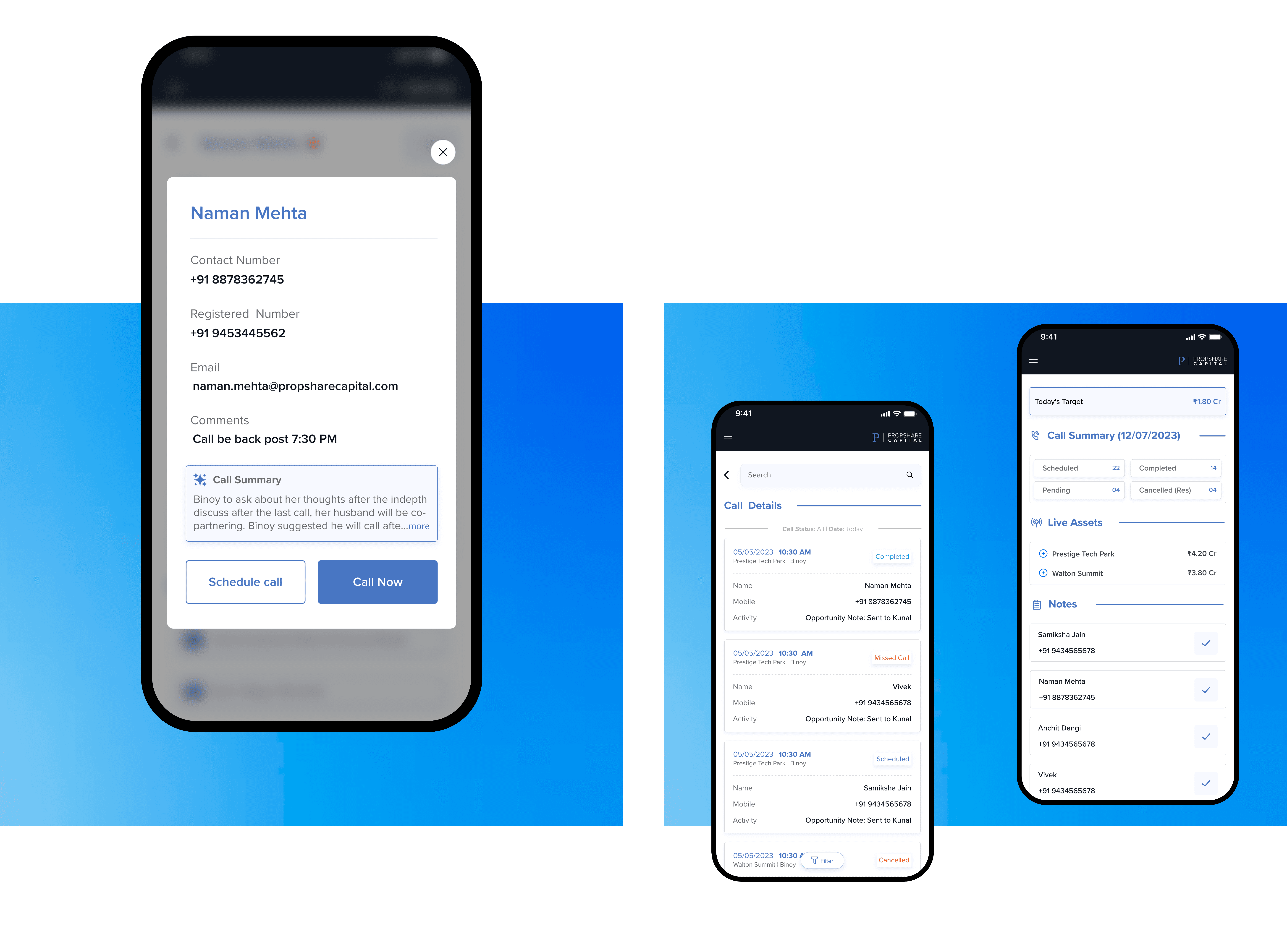
A conversation summary that helps sales pick up where they left off.
International clients meant conversations could sit unanswered for hours. When a salesperson returned, they shouldn't have to reconstruct the relationship from a message thread. The summary gave them the context they needed before they replied.
DECISION 4
Client knowledge shouldn't leave when the salesperson does.
Reps were keeping important context in personal notes, reminders, and memory. It worked until someone was unavailable or a relationship changed hands. I brought that context into the product, making notes and reminders part of the shared client record.

REFLECTION
Sometimes the better design decision is to work with the existing system and build the missing layer around how people actually work.
Reframing the brief from “make the admin responsive” to “keep clients moving when executives aren't at their desks” turned a responsive redesign into a focused mobile sales workflow, driving 40% more opportunities, 60% faster responses, and 22% more on-time follow-ups.
Sales Funnel
%
increase in qualified opportunities over 90 days
Lead Response Time
%
reduction in average response time for international leads
Follow-up Completion
%
increase in on-time follow-ups within 90 days post-launch